
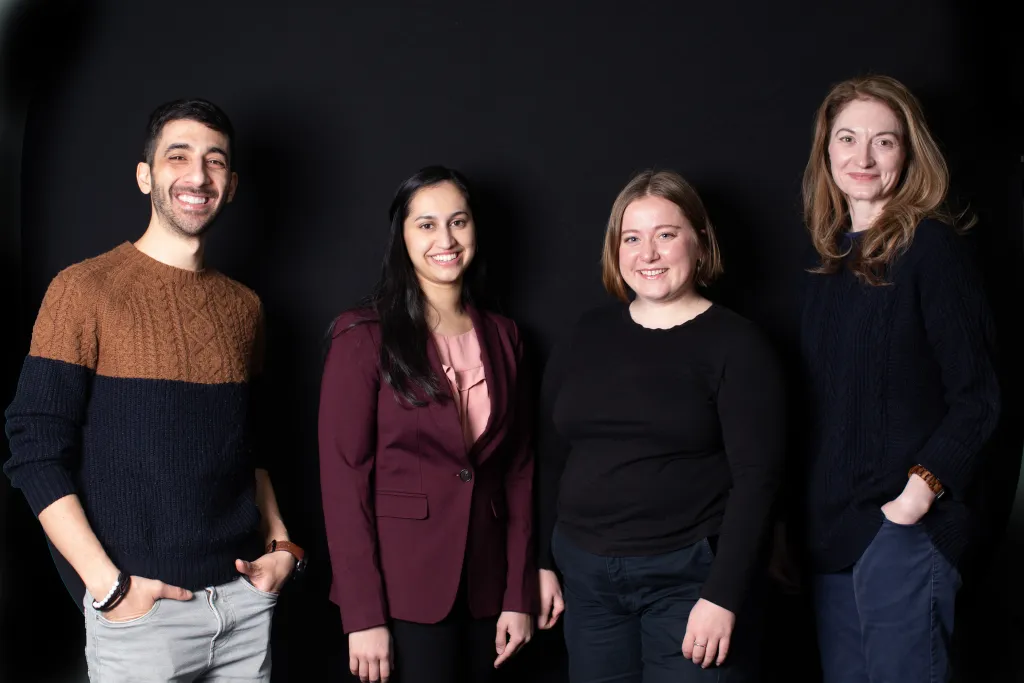
Scientific research can appear isolated from other branches of society. However, its impacts extend far beyond the lab. Ongoing research shapes healthcare and public policy. Research funding determines what kind of research questions are pursued at the research bench. Partnerships that cross national borders of scientific institutions are integral parts of international relations. Overall, science is deeply intertwined within the societies around it. Yet, many scientists who spend years to become experts in their fields of research are unaware how they can explore these connections or influence policy-making directly. Here, the co-founders of SCOPE share their journeys from the bench into advocacy, science policy, and education, while highlighting how SCOPE is helping the next generation of scientists to engage with the world beyond the research system.
Rohini
During my undergraduate training, I began preparing for a career as a physician-scientist – one where I could diagnose and care for patients while investigating new treatments to advance human health. I was drawn to translational research but became increasingly aware of the limitations of a narrow “bench-to-bedside” pipeline focused on bringing discoveries into clinical trial. This led to an interest in what followed treatment approval and whether treatments could be implemented effectively and equitably. As a physician-in-training, I see patients struggle with navigating prior authorization, insurance coverage, and additional barriers to treatment. As a scientist, I see how financial incentives shape which diseases receive attention. These structural issues have shown me that advancing human health requires the ability to reform policies and systems that determine how discoveries reach patients. By bridging science, medicine, and policy, SCOPE can ensure scientific discoveries translate into accessible, effective care for patients in need.
Rebecca
“Growing up” in research, everyone in my network stayed within academia. There were, of course, exceptions for the rogue scientists who went to industry but I hadn’t considered that scientists could step outside those boxes. Luckily, I stumbled across an announcement for a new seminar course in something called “Science Diplomacy” during my postdoc. By the end of the first session, I was inspired by the instructors’ own stories of their contributions to policymaking and international relations. I knew this was my future. I transitioned to a position with the British Government, working to strengthen UK-US scientific partnerships and advise UK science policymaking. After several years focused on UK-US cyber security and defense science, I returned to academia (and the biosciences) to take on leadership of Cold Spring Harbor Laboratory’s (CSHL) science think tank: the Banbury Center. It was here, at CSHL, where I connected with three early career colleagues who weren’t going to wait to stumble upon a science diplomacy course to provide them with inspiration. With the full support of the CSHL President, we envisioned SCOPE as a way to reach scientists early in their careers. SCOPE provides accessible ways to gain experience thinking about science policy issues, connecting with peers, and gaining skills useful in non-research careers. Whether they end up pursuing a policy career or continuing in research, we want SCOPE to strengthen their connection to policy and society.
On reflection, it wasn’t luck that brought me to science policy. It was the determined efforts of other scientists sharing their knowledge and creating opportunities. I hope SCOPE can be the “luck” for those making their way now.
Emma
During my undergraduate degree, I studied and conducted research in five countries, an experience that taught me that science is shaped as much by the scientists as by the political and social context they work in. I had always been drawn to science for its capacity to produce knowledge and solutions for the people who need them most, but those years abroad made clear that this capacity is not self-sustaining. Instead, it depends on public trust, on institutions that respond to the communities they serve, and on political support that scientists too often assume someone else will secure. I became involved with SCOPE because most scientists finish their degrees without having read a piece of legislation, spoken with a policymaker, or been asked what their work means to anyone outside their field. To me, SCOPE exists to build a generation of scientists fluent in both the science they produce and the policy that shapes whether it reaches anyone.
Stefano
I didn’t start out in academia thinking about science policy. Instead, I was driven by curiosity and wanted to understand the brain. During my PhD I loved science and went on to pursue a postdoc. During this time, I started seeing the cracks in the system: inequity in funding and pay, colleagues struggling with visas, parents without childcare, and postdocs with no recourse against harassment.
As a result, I joined my union because they were working on real change, so that these scientists could continue their important work, without worrying about whether they could pay rent, or school for their kids. I ended up on the bargaining committee, helping draft anti-harassment policies, and lobbying for biomedical research funding. I learned that science doesn’t happen in a vacuum—we are the experts, we should be actively involved in drafting policies and communicating with the public.
I co-founded SCOPE to give early-career scientists these exact skills: how to interact with policymakers, how to advocate for their research, how to communicate science to the public. Science belongs to everyone—and we have a responsibility to make it accessible.
I hope SCOPE becomes a launching pad for scientists who want to understand how their work fits into the world—and who want to help shape it.
Leave a Reply